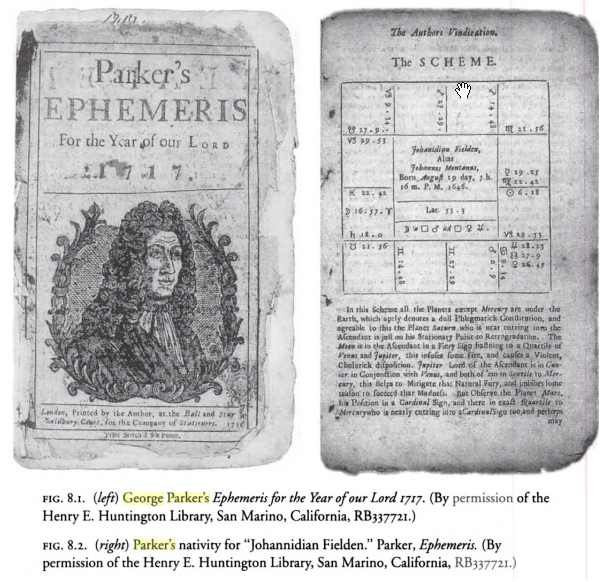
George Parker, a British astrologer, published an ephemeris, using heliocentric positions, with his partner, Dr. John Partridge in 1680.


from Parker’s Tutor²: a Sun in Leo gives a large voice, broad face and a mark on the aspect. An honourable character, faithful to his friend and just in his promises. He takes pleasure in Warfare and propagates all matters and things tending thereto.

The top engraving is from Parker’s frontispiece to his Ephemeris. It includes a sample page of its layout.
Astrologer Ebenezer Sibley in his “The New and Complete Illustration of the Celestial Science of Astrology” gives 05:13 a.m. with the Julian date of August 9, 1654 at 5:11 GMT at Shipston-on-Stour, England for Parker. The above chart has been converted to the Gregorian calendar.
What is noticeable is Sibley is using a wheel for his chart and not the popular box. Is this the first published use of the wheel? Other questions arise. Was the wheel more popular than we knew?

Alan Leo in his Urania Magazine¹ uses August 9th too but 5:11 AM GMT. We are using Leo’s data because we think Leo is the better astrologer. He also used the Placidus house system, while we of course are using Morinus we are just a few minutes off his placements i.e. Sun in Leo 26.16 vs our 26.12, Saturn in Leo 29.34 vs. our 29.15 and Mercury in Virgo at 23.31 vs. our 23.30. This has nothing to do with the house system, but because our calculations are via computer while Leo was done by hand. It is impressive how accurate are Leo’s calculations.
the Tutor: Parker’s Mars in Leo is a person indifferent stature, well fed body but not grossly large. Light brown hair towards flaxen, oval visage and full eyes. Fierce countenance, quick sight, active and valiant but a choleric personality. Generous and free-hearted delighting in all manner of argument and warlike exercise like shooting, riding and fencing.
Parker a Choo-choo
With his water Grand Trine, Parker has several conjunctions, but no stelliums in his chart. Instead he has what Marc Jones called “preponderances.” What is the difference? Stelliums are when all the planets of the same sign are in one house. A preponderance OTOH is when there are planets have mixed signs in one house.
He has one major opposition, that from Jupiter to Mercury, so Parker cannot be a Splay, as that requires none. He also one too many conjunctions, with no associated oppositions, for a Splash.
All that is left is for Parker as a locomotive with an open area in the South, suggesting despite his wish to be unobtrusive, he had a public personality. Obviously because of his publications.
Parker has two squares to his trine, one from the Mars on the first house cusp to the Moon it’s essential ruler, tells he used his intuitive creativity to unleash his personal viewpoints.
The second square is from Jupiter, which is in exaltation in Pisces to Pluto (yes Pluto has not yet been discovered but we are using it anyhow). This aspect shows the tension between the two planets Parker has to manage: he did not just come with some wild-eyed ideas that floated away, but wrote them down, and tested them thoroughly, with his keen eye of observation and industrious research.
the Tutor: Parker’s Moon in Scorpio gives him a very fat and short neck, a broad face, black hair and ill proportions. A dull constitution and one depraved of all principles having little esteem from his neighbors and fellow man.
With a strong first house, and a Sun at 26 Leo 12 conjunct the asteroid Daedalus, his ingenuity was hard to be denied and Saturn at 29.15 Leo conjunct the Fixed Star Regulus there was also his ambition. He also has a conjunction of the asteroid Sphinx 16.39 Leo conjunct Mars in 16 Leo 46. He put great effort into solving hard problems and Mercury at 23.30 in Virgo conjunct exactly with Pandora that showed how he loved to show his solutions off .
the Tutor, Parker’s Saturn in Leo makes an “indifferently large stature with broad shoulders, big-boned and well put together but not fleshy. The hair is of a light brown, and he stoops when he walks. He has rough mannerisms and tends towards revengeful yet would be thought by others to be the spirit of generosity and nobleness in all his actions.
None of that seems much of a stretch, but Bacchus conjunct Uranus in Capricorn tells us he likes to imbibe and enjoyed the pub house. Venus in Cancer on the twelfth house suggests he had a great love that encouraged him, but square Iris in the third. It is possible that this is an idealized love of his sister or sister-in-law. That seemed to bring him pain as well, as Sphinx is opposite Eos 17 Aquarius and creates a point focus at his natal Moon 17 Scorpio 19.
The Tutor, Mercury in Virgo, is a slender body, handsome man, but a muddy complection, long visage and dark brown hair. A sharp wit and notable penetrating fancy attaining to diverse languages, arts or sciences by his own industry.
It is hard to know who this was or how this turned out, but the Moon in Scorpio gives us a clue of a jealous nature and perhaps suggests an unrequited love where, because of circumstance he was forced to remain just friends with her.
Could this be Partridge’s wife, Dorothy? Or since it conjunct his Part of Fortune, could this be professional jealousy, quiet because his inability to to capitalize more fully on his talents, and so someone else did? Dunno, but we know some type of jealousy, professional or personal colored his view. As for who or which this was, that is a cipher, for true to his wishes nothing besides his almanac is known. He lived long and died in London in 1743. As for his partner, Dr. Partridge, that’s another story.
from the Tutor, Parker’s Jupiter in Pisces, where it is exalted we find, “Here is a person of middle stature, the body gross, the complexion not clear, and skin dark complected with brown hair. Temper and qualification is honest and just and he delights in good company and pleasant recreations with his fellows. He loves mirth and musical instruments in the world and is fortunate upon water.”
Footnotes:
- Leo, Alan, Urania Magazine, publisher Alan Leo, London. January 1800,
- Parker, George, A Tutor to Astrology, Whereunto is added an Ephemeris, 1704, London.